Auxiliary Equation: A Repeated Real Root
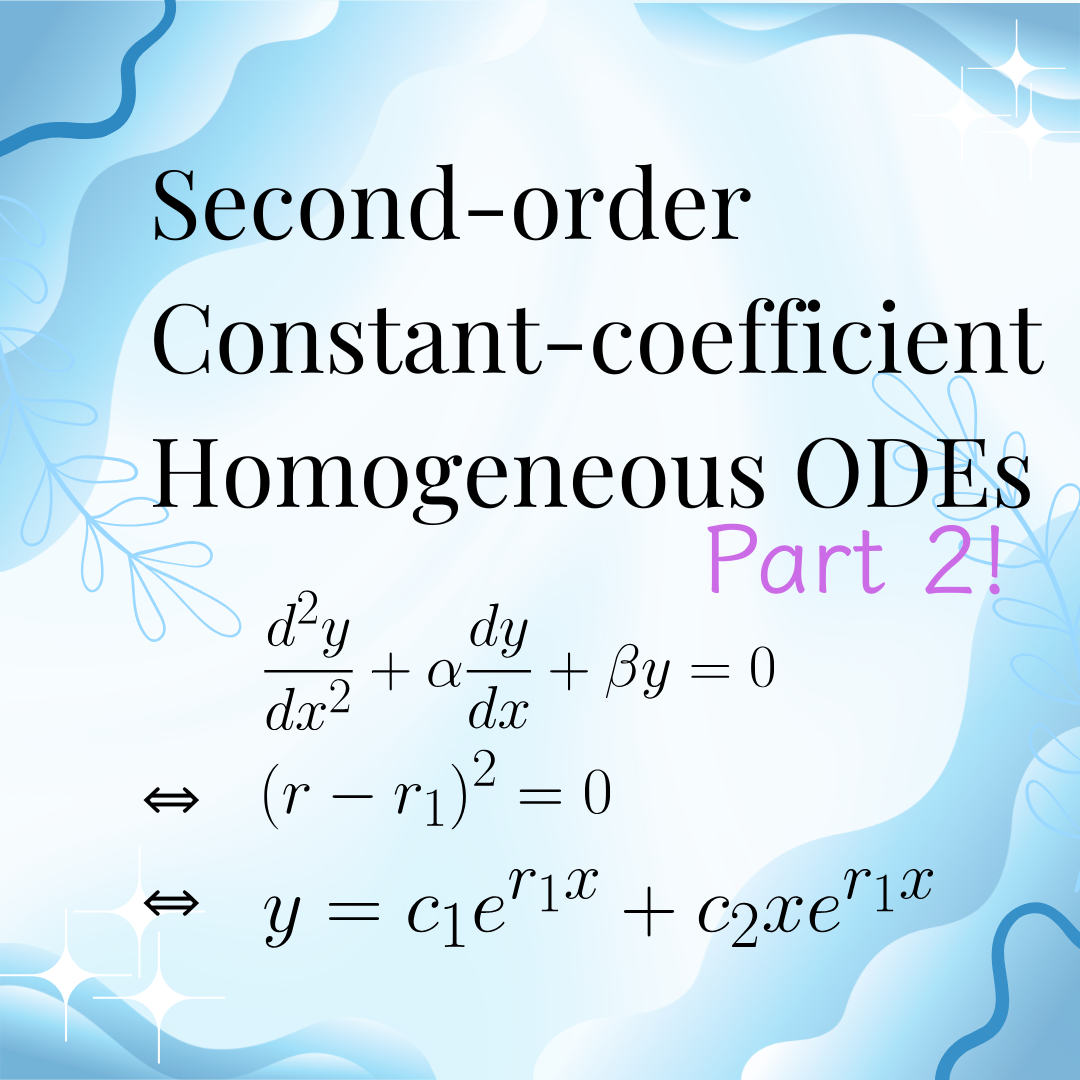
The next case for the auxiliary equation, introduced in the last tutorial, is a repeated real root, so that \( r = r_1 \) solves
\begin{align}
r^2 + \alpha r + \beta = (r -r_1)^2 = 0 \tag{1}
\end{align}
Expanding the square shows that it must be \( \alpha = -2r_1 \) and \( \beta = r_1^2 \). By the same logic before, we know that \( y_1 = e^{r_1 x} \) will be one possible solution. However, since the root is now a repeated one, we don’t automatically get two linearly independent solutions as in the case of two real roots.
To complete our solution, notice that with a constant \(k\), \( ky_1 = ke^{r_1 x} \) is obviously also a solution, though it is clearly not linearly independent from \( y_1 \). Our trick is to replace \( k \) by \( x \), hoping that by increasing the degree by one, the new form \( y_2 = xe^{r_1 x} \) will remain a valid solution and at the same time address the linear independence issue. This indeed works, because by (1), the ODE will read \( d^2y/dx^2 -2r_1 dy/dx + r_1^2 y = 0 \), and substituting shows that
\begin{align}
& \frac{d^2y_2}{dx^2} -2r_1 \frac{dy_2}{dx} + r_1^2 y_2 \\
={}&\frac{d^2}{dx^2}(xe^{r_1 x}) -2r_1 \frac{d}{dx}(xe^{r_1 x}) + r_1^2 (xe^{r_1 x}) \\
={}&\frac{d}{dx}(e^{r_1 x} + xr_1e^{r_1 x}) -2r_1 (e^{r_1 x} + xr_1e^{r_1 x}) + xr_1^2e^{r_1 x} \\
={}&(2r_1e^{r_1 x} + xr_1^2e^{r_1 x}) -2r_1e^{r_1 x} -2xr_1^2e^{r_1 x} + xr_1^2 e^{r_1 x} \\
\equiv{}&0 \tag{2}
\end{align}
is solved, and the linear independence part can be easily confirmed by computing the Wronskian:
\begin{align}
W[y_1, y_2](x) &=
\begin{vmatrix}
e^{r_1x} & xe^{r_1x} \\
(e^{r_1x})’ & (xe^{r_1x})’
\end{vmatrix} \\
&= \begin{vmatrix}
e^{r_1x} & xe^{r_1x} \\
r_1e^{r_1x} & e^{r_1 x} + xr_1e^{r_1 x}
\end{vmatrix} \\
&= e^{2r_1x} + xr_1e^{2r_1 x} -xr_1e^{2r_1 x} \\
&= e^{2r_1x} \neq 0 \tag{3}
\end{align}
Other than guessing and direct substitution as in (2), a more mathematical way leading to the ansatz is to write the ODE in the form of operators
\begin{align}
(\frac{d^2}{dx^2} -2r_1 \frac{d}{dx} + r_1^2) y = (\frac{d}{dx} -r_1)^2 y = 0 \tag{4}
\end{align}
It is already known that \( y_1 = e^{r_1 x} \) solves (4), and from this, by a further partial derivative with respect to the parameter \( r_1 \), we have
\begin{align}
\frac{\partial}{\partial r_1}[(\frac{d}{dx} -r_1)^2 (e^{r_1 x})] &= 0\\
(\frac{d}{dx} -r_1)^2(xe^{r_1 x}) -2(\frac{d}{dx} -r_1)(e^{r_1 x}) &= 0 \\
(\frac{d}{dx} -r_1)^2(xe^{r_1 x}) -2(r_1e^{r_1 x} -r_1e^{r_1 x}) &= 0 \\
(\frac{d}{dx} -r_1)^2(xe^{r_1 x}) -2(0) &= 0 \\
(\frac{d}{dx} -r_1)^2(xe^{r_1 x}) &= 0 \tag{5}
\end{align}
So \( y_2 = xe^{r_1 x} \) also solves (4). As an extra challenge, you may try to use the same method to argue that \( x^2e^{r_1 x} \) is not a valid solution in this case.
Example
Now we will work on solving
\begin{equation}
\frac{d^2y}{dx^2} -2\frac{dy}{dx} + y = 0 \tag{6}
\end{equation}
with the initial conditions of \( y(0) = 1, y'(0) = 3 \).
The auxiliary equation is
\begin{align}
r^2 -2r + 1 &= 0 \\
(r-1)^2 &= 0 \tag{7}
\end{align}
so \( r = 1 \) is a repeated (real) root. According to the explanation above, two linearly independent solutions will be \( y_1 = e^x \) and \( y_2 = xe^x \), and so the general solution takes the form of \( y = c_1e^x + c_2xe^x \) and thus \(y’ = c_1e^x + c_2(xe^x + e^x) \). Plugging in the I.C. leads to
\begin{align}
&\left\{
\begin{aligned}
c_1(1) + c_2(0) &= 1 \\
c_1(1) + c_2(0+1) &= 3
\end{aligned}\right. \\
& \Rightarrow c_1 = 1, c_2 = 2 \\
& \Rightarrow y = e^x + 2xe^x \tag{8}
\end{align}
Exercise
Solve the second-order ODE
\begin{align}
\frac{d^2y}{dx^2} +4\frac{dy}{dx} + 4y = 0 \tag{9}
\end{align}
that has the I.C. \( y(0) = 2, y'(0) = -5\).
Answer
The auxiliary equation is \( r^2 + 4r + 4 = 0 \) which can easily be seen to have the repeated root of \( r = -2 \). Hence the general solution will be a linear combination of \( y_1 = e^{-2x} \) and \( y_2 = xe^{-2x} \), that is, \( y = c_1 e^{-2x} + c_2 xe^{-2x} \), and hence \( y’ = c_1 (-2e^{-2x}) + c_2 (-2xe^{-2x} + e^{-2x}) \). Substituting the I.C. results in
\begin{align}
&\left\{
\begin{aligned}
c_1(1) + c_2(0) &= 2 \\
c_1(-2) + c_2(0+1) &= -5
\end{aligned}\right. \\
& \Rightarrow c_1 = 2, c_2 = -1
\end{align}
Therefore the full solution is \(y = 2e^{-2x} -xe^{-2x}\).





發表迴響